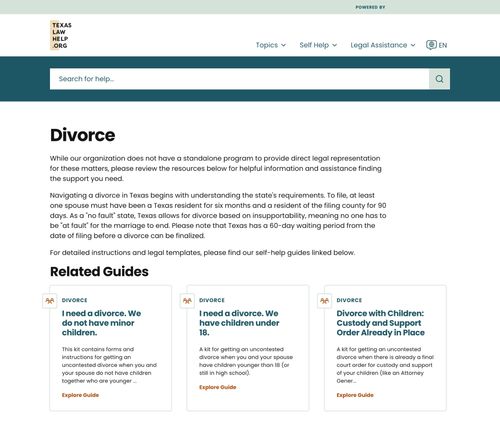
Texas Legal Services Center (TLSC) is a Texas-based nonprofit that provides free legal assistance to low-income individuals across multiple programs — including Veterans services, Crime Victims/LASSA, Family Helpline, and Kincare. Each program relied on staff manually sorting through client voicemails, transcribing callback numbers, and entering data into LegalServer — a time-consuming, error-prone process that slowed down access to legal help for the people who needed it most.
Chromatic partnered with TLSC over three interconnected phases to design, build, and scale a custom "Call Manager" application that automatically processes incoming voicemails from VOXO, applies program-specific business logic, and routes data into LegalServer — all without retaining any personally identifiable information. In parallel, Chromatic began work on a full Online Intake Portal to further modernize client intake across TLSC and its partner organizations.
Central to every phase of this engagement was a rigorous, collaborative discovery process. Chromatic conducted extensive stakeholder interviews and working sessions with program managers across multiple TLSC departments, ensuring that each program's unique grant requirements, eligibility criteria, case-handling rules, and operational constraints were fully understood and accurately mapped before any technical work began.
TLSC's intake process depended entirely on staff manually reviewing voicemails, looking up callers in LegalServer, and determining the appropriate next action — whether creating a new prescreen, reopening an existing case, or logging a note. The complexity ran deeper than volume alone:
Chromatic approached this engagement in three phases, each grounded in structured discovery before moving into build.
Before writing a line of code, Chromatic conducted a discovery phase to understand how TLSC's highest-volume program handled intake. This involved direct interviews with program staff and managers to document the most common call scenarios, the rules governing each outcome, and the edge cases that required human judgment. From those sessions, Chromatic produced a stack-ranked roadmap of intake flows and built an MVP focused on the highest-impact use cases.
The resulting application was a lightweight, stateless "middleman" that:
The MVP was completed in 10 weeks at a significantly reduced cost, giving TLSC a production-ready system before committing to a full-scale expansion. Within weeks of launch, the application had automatically processed approximately 1,000 voicemails — replacing what had been an entirely manual, staff-intensive workflow.
Expanding the Call Manager to five additional programs — Front Desk, Veterans, Crime Victims/LASSA, Family Helpline (FHL), and Kincare — required starting from scratch on discovery for each one. Chromatic facilitated dedicated working sessions with each program's managers to surface the rules, grant-driven constraints, and edge cases that would govern that program's intake logic.
Each program had its own definition of what a valid intake looked like, what LegalServer case statuses meant in context, and what should trigger escalation or manual review. Getting that right required real conversations with the people running those programs — not assumptions.
That discovery work produced detailed intake flow specifications for each program before development began, including:
| Program | Key Discovery Findings |
|---|---|
| Front Desk | Info-only prescreens; required cross-program case lookups and duplicate callback prevention; grant rules did not allow case creation at this stage |
| Veterans | Case reopening logic for returning callers; frequent multiple legal issues per call; custom note-handling requirements tied to grant reporting |
| Crime Victims/LASSA | All voicemails must be processed regardless of status; strict escalation criteria; grant restrictions required isolation from cross-program lookups |
| Family Helpline (FHL) | Every call treated as a new prescreen regardless of prior history; specific note formatting requirements for grant compliance |
| Kincare | Simpler intake flow but still required documented acceptance criteria and LegalServer field mapping |
The Phase 2 build followed a structured sequence: a 2-week discovery and workflow mapping phase, followed by core integration scaffolding, 6-8 weeks of custom intake logic development, notification and email enhancements, quality assurance, and a phased per-program rollout. Each program was activated independently in the live Call Manager, with shadow periods where staff manually verified system-handled calls before full cutover.
The Online Intake Portal represented the most discovery-intensive phase of the engagement. Because the portal would need to serve multiple programs — each with its own eligibility rules, grant requirements, and intake pathways — Chromatic conducted a comprehensive workflow mapping effort in close collaboration with TLSC program managers across departments.
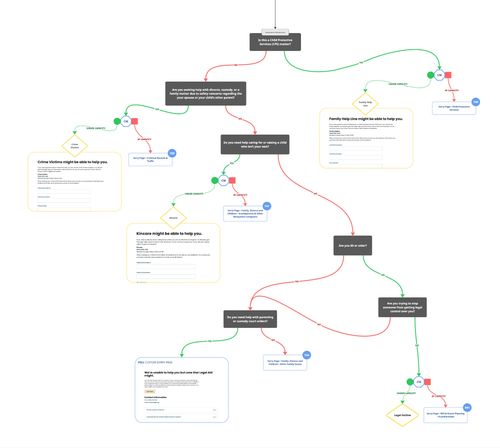
Working sessions produced detailed intake flow diagrams for every program and intake scenario, covering:
That diagramming and flow-mapping work was not a preliminary step — it was the foundation of the technical architecture. The Intake Manager application's rules engine, the form tool's conditional logic, and the dashboard's capacity controls were all built directly from what was surfaced in those sessions.
The depth of the discovery work on the portal is what made a modular, scalable architecture possible. Without that clarity, we would have been engineering against assumptions rather than against a shared, validated understanding of how intake actually works across TLSC's programs.
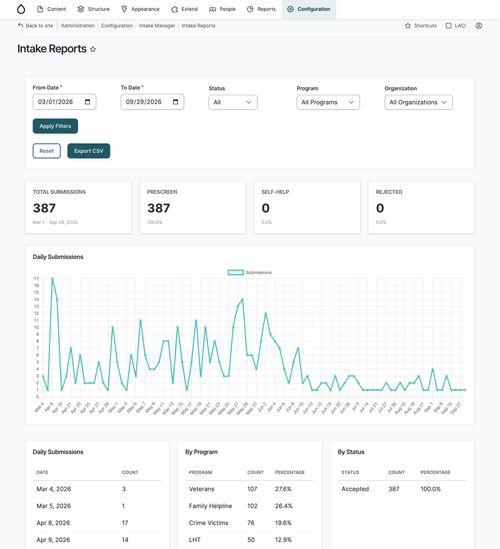
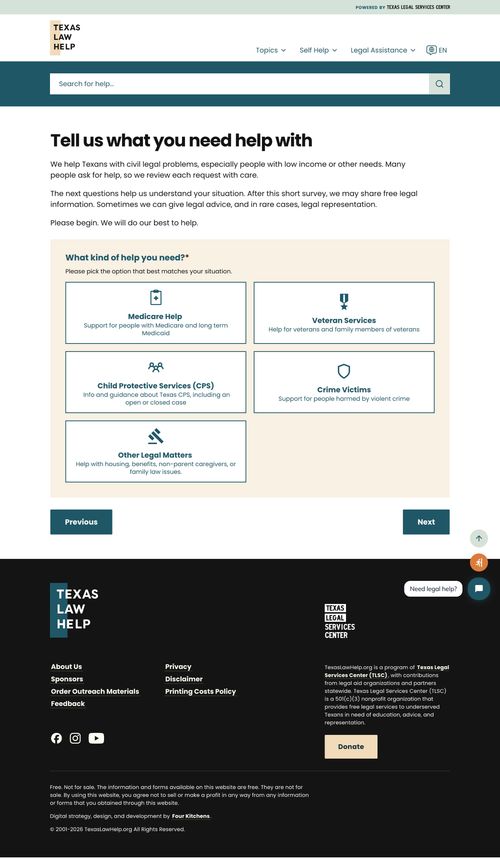
The portal's architecture comprised five integrated layers: a HIPAA-compliant third-party intake form with conditional branching and multilingual support; a custom Intake Manager middleware application extending the Call Manager's rules engine; an internal staff dashboard with real-time capacity meters and role-based access; API connections to TLSC's LegalServer and partner organizations; and fallback flows to TexasLawHelp.org's existing AI companion for ineligible applicants.
The partnership between Chromatic and TLSC produced measurable operational improvements alongside a scalable, well-documented technical foundation for the future of legal intake in Texas:
What began as a focused automation pilot evolved into a multi-phase partnership redefining how TLSC connects Texans in need with legal services. The technical architecture — lightweight, API-first, privacy-preserving — was made possible by an equally rigorous approach to discovery. By investing time in structured interviews and working sessions with program managers before building anything, Chromatic was able to translate complex, grant-driven operational rules into software logic that actually reflects how each program works.
That pattern repeated across every phase: understand the human process first, document it clearly, then engineer a solution precise enough to be trusted. For an organization where intake accuracy directly affects vulnerable clients' access to legal help, that approach wasn't optional — it was the work.